Santorini After 50: A Comfort-First Guide for Travelers 50+
Santorini's beauty is real — and so are its stairs. Here's how to experience the island's magic without the cliffside climbs ruining your trip.
⚡ Key Takeaways
- The stairs are the whole story: Oia and Fira are built on steep cliffs with hundreds of steps. Plan around this, not through it.
- Flattest bases: Kamari and Perissa (east-coast beach towns) — flat, walkable, relaxed.
- Best caldera views with less effort: Imerovigli — quieter than Oia, stunning views, fewer crowds.
- Cruise vs. stay: staying 3–4 nights beats a rushed cruise day visit for comfort.
- Best months: May–early June and September — warm, calmer, better prices.
- Catamarans: wonderful but check boarding carefully — some require climbing and getting wet.
Is Santorini Worth It After 50? The Honest Answer
Yes — but only if you go in with open eyes. Santorini is one of those places that genuinely lives up to the photographs: the whitewashed villages clinging to volcanic cliffs, the impossibly blue Aegean, sunsets that draw applause. For many travelers, it's a once-in-a-lifetime destination, and there's no reason 50+ should disqualify you.
The honest caveat, and it's a big one: Santorini is fundamentally vertical. The island is the rim of a drowned volcanic caldera. The famous towns — Oia, Fira, Imerovigli — are stacked down cliff faces. Stairs aren't an occasional inconvenience here; they're the architecture. A "short walk" in Oia can mean 80 steps down and 80 steps back up. Cave hotels, the island's signature accommodation, are often carved into the cliff with multiple levels connected only by stairs.
This doesn't mean skip Santorini. It means choose your base and your hotel with stairs as the #1 criterion — ahead of views, ahead of price, ahead of everything. This guide shows you how.
Where to Stay: The Area Decision Matters More Than the Hotel
Kamari & Perissa — Flattest, Most Relaxed
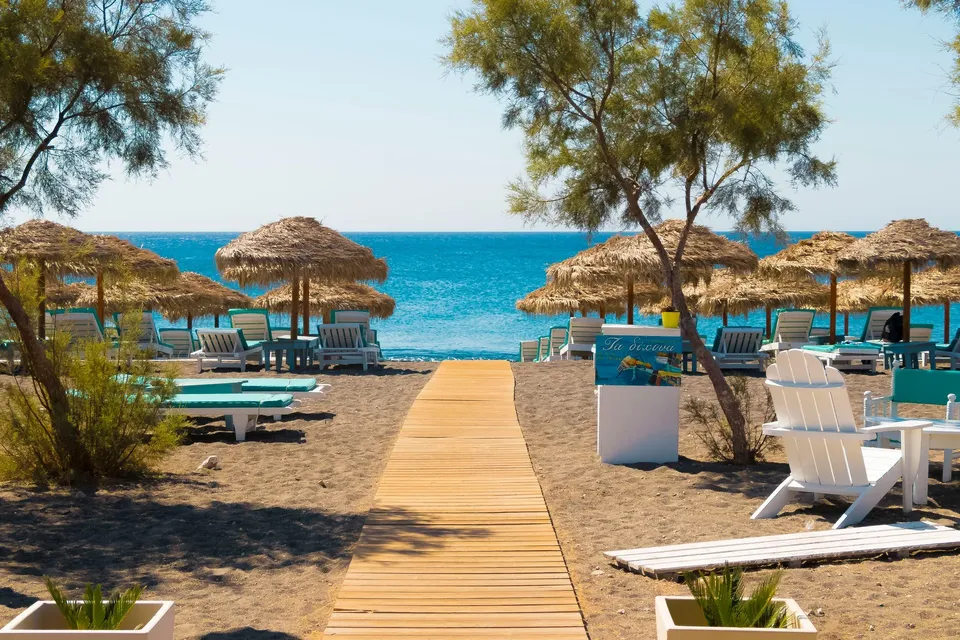
On the island's east coast, these beach towns sit on flat ground. Kamari has a long black-sand beach promenade lined with restaurants — genuinely walkable, no cliffs, no drama. Perissa is similar, slightly livelier. You won't have caldera views from your room, but you'll walk out your door onto level ground every morning. For travelers whose knees set the itinerary, this is the smartest base. The caldera towns are a 15–20 minute taxi or bus ride away for sunset visits.
Imerovigli — Caldera Views, Quieter, Fewer Crowds
Perched on the caldera between Fira and Oia, Imerovigli offers the same jaw-dropping views with a fraction of Oia's foot traffic. It's still cliffside — stairs exist — but the village is smaller, calmer, and many hotels here are set up for a more relaxed clientele. If you want to wake up to the caldera, this is the comfort-first choice. Key: email the hotel and ask exactly how many steps from the nearest road or parking to your room.
Fira — The Capital, Bustling, Steep
Fira is the island's main town: shops, restaurants, the cable car, cruise-ship crowds. It's lively and convenient — and built on a cliff. The main pedestrian street along the caldera edge is relatively level, but venturing down (or staying in a cave hotel below the rim) means serious stairs. Fine for a day visit; think carefully before sleeping here if steps are a concern.
Oia — Iconic, Crowded, Steepest
Oia is the postcard: blue domes, cave houses, the famous sunset. It's also the steepest, most crowded, and most expensive part of the island. The main marble-paved street is manageable, but the side lanes plunge downward in staircases. Visit for sunset (arrive early, leave before the post-sunset crush), but sleeping in Oia means committing to stairs multiple times a day.
Area Map
See where each area sits. Green = best for comfort; yellow = good with caveats; red = visit, don't stay.
Area Comparison at a Glance
| Area | Terrain | Caldera Views | Senior Comfort |
|---|---|---|---|
| Kamari / Perissa | Flat | No (sea views) | ★★★★★ Easiest base |
| Imerovigli | Cliffside, moderate | Yes — spectacular | ★★★★ Quiet, check steps |
| Fira | Cliffside, steep | Yes | ★★★ Visit; stay with care |
| Oia | Cliffside, steepest | Yes — iconic | ★★★ Sunset visit only |
Hotel Comfort Checklist: Santorini Edition
✅ Before you click "book," confirm:
- Exact step count — email the hotel: "How many steps from the nearest vehicle drop-off to the room entrance?" Get a number, not "a few steps."
- Elevator? — most traditional cave hotels have no elevator at all. Modern hotels in Kamari/Perissa are more likely to have one.
- Room level — ask for the highest accessible level (fewest stairs down from the road) or ground-floor rooms in flat areas.
- Luggage handling — confirm the hotel will carry bags up/down stairs. Many do; verify before arrival, not after.
- Pool access — infinity pools are often down steep steps from the room. Ask.
- Air conditioning — essential June through September. Santorini's white buildings reflect heat, but rooms bake in summer.
- Breakfast logistics — is breakfast served at your level, or down 40 steps at the pool deck?
Cruise Day Visit vs. Staying on the Island
Many travelers first encounter Santorini as a cruise port. Here's the honest comparison for 50+ comfort:
Cruise day visit: You tender from the ship to the old port of Fira, then face the ascent — a cable car with long queues in season, a steep 30-minute walk, or the famous donkey ride (uncomfortable and ethically fraught; skip it). You get 5–6 hours, mostly in Fira's crowds, then reverse the whole process. It's a lot of effort for a rushed taste.
Staying 3–4 nights: You arrive once, settle in, and explore at your own pace — Oia at sunset on your schedule, a relaxed morning in Imerovigli, a beach day in Kamari. No queues dictating your day. For comfort, staying wins decisively.
If a cruise is how you're traveling anyway, consider: some itineraries overnight in Santorini, which changes the math entirely — you get the evening without the day-trippers.
Catamaran Tours: Wonderful, With Caveats
A caldera catamaran cruise — sailing past the cliffs, swimming in hot springs, sunset on the water — is many visitors' highlight. For 50+ travelers, a few honest notes:
- Boarding: you typically board from a small boat or beach — expect to step between boats, possibly get your feet wet, and climb a short ladder. Ask the operator about boarding assistance.
- Choose a larger catamaran over a small sailboat — more stable, proper restrooms, shaded seating.
- Semi-private or small-group tours (10–20 people) beat the 50-person party boats for comfort and space.
- Morning tours are calmer (less wind) than afternoon ones; sunset tours are magical but sell out and cost more.
- Seasickness: the caldera is sheltered, but the open-water stretches can roll. If you're prone, take precautions and sit mid-boat.
When to Visit
May through early June and September are the sweet spots: warm enough to swim (70–80°F / 21–27°C), wildflowers in spring, harvest season in fall, and — critically — thinner crowds on those narrow cliff paths. July and August bring 85–95°F heat, peak prices, and Oia's lanes packed shoulder-to-shoulder. The stairs are hard enough without doing them in a crowd at 90°F.
April and October are quieter and cheaper; the sea is cool in April, pleasant in October. Many restaurants and hotels begin closing in late October. Winter (November–March) is genuinely quiet — some find it magical, but many businesses shut and ferry schedules thin out.
Getting Around the Island
- Taxis are the comfort-first choice — agree on the fare or confirm the meter before departing. Pre-book for sunset returns from Oia; demand spikes.
- Local buses (KTEL) connect Fira to Oia, Kamari, Perissa, and the airport cheaply, but they get crowded in summer and involve standing.
- Rental car: the island is small and roads are decent, but parking in Oia and Fira is a nightmare in season. Only worth it if staying in Kamari/Perissa with hotel parking.
- ATV/quad rentals are popular but genuinely risky on cliff roads — accident rates are high. Skip them; your trip isn't worth the gamble.
How Much Time Do You Need?
Three to four nights is the sweet spot: a day for Fira and Imerovigli, a sunset in Oia, a catamaran day, and a slow beach morning in Kamari or Perissa. Two nights feels rushed; a week is lovely if you want a true rest, with day trips to the ancient site of Akrotiri (fascinating, flat, shaded — the "Minoan Pompeii") and the island's wineries.
Frequently Asked Questions
Can you avoid stairs entirely in Santorini?
Not entirely if you want the caldera views — but you can minimize them dramatically. Stay in Kamari or Perissa (flat), take taxis to viewpoints, and visit Oia's main street (relatively level) rather than descending into the lanes. Choose hotels where you've confirmed the step count in advance.
Is the donkey ride up from the old port okay?
We recommend skipping it. The ride is uncomfortable, the animals' welfare is a longstanding concern, and the cable car (despite queues) or a taxi to Fira are better options.
Is Santorini safe for solo women travelers?
Santorini is generally very safe, with low crime rates. Standard travel awareness applies. The main risks are physical — stairs, heat, slippery stone — not personal safety.
Do I need cash, or are cards accepted?
Cards are widely accepted in hotels, restaurants, and shops. Carry some cash for small tavernas, buses, and tips.
Get Santorini Ideas in Your Inbox
Join the free waitlist for hand-picked travel ideas, comfort-first hotel notes, and fare alerts — written for travelers 50+.
Join the Free Waitlist