Washington DC After 50: A Comfort-First Guide for Travelers 50+
The capital without the strain: free Smithsonian museums, the half-price senior Metro fare, the National Christmas Tree, and ZooLights — all at a comfortable pace.
⚡ Key Takeaways
- The museums are free: every Smithsonian museum costs $0 — the world's greatest free museum collection, all on one flat, walkable Mall.
- Senior Metro fare: riders 65+ pay half fare with a free Senior SmarTrip card — about $1.10 on the bus, $1.10–$3.35 on the Metro.
- Book the passes first: the Washington Monument, the African American history museum, Air and Space, and the National Zoo all need free timed-entry passes.
- December is the moment: the National Christmas Tree is free to visit Dec 5–Jan 1, and ZooLights runs select nights Nov 20–Jan 3 ($10).
- The honest catch: the Mall is about two miles end to end — plan one museum per half-day and ride the Metro between stops.
- Arrive by Metro: Reagan National Airport (DCA) has Blue and Yellow line stations right at the terminal.
Is Washington DC Worth It After 50? The Honest Answer
Washington is one of the rare American cities that gets better after 50. The reason is simple: the country's greatest museums are free, the ground is flat, and the transit system gives you a 50% discount at 65. There is no other US city where you can spend three days seeing world-class art, space capsules, presidential history, and the seat of government without paying a dollar of admission — and the city rewards the unhurried traveler, because the museums are built for slow looking, with benches, cafés, and restrooms everywhere.
The honest caveat is scale. The National Mall looks compact on a map and is not: it runs about two miles from the Capitol to the Lincoln Memorial, and a museum that looks "next door" is a 20-minute walk away. The 50+ strategy is to treat the Mall like a series of half-days — one museum per morning, a long lunch, one memorial in the afternoon — and to ride the Metro between stops instead of walking the whole spine. Do that, and DC is genuinely one of the easiest big-city trips in America. Pair it with our Boston guide for a two-city American-history trip.
Where to Stay: Penn Quarter vs. Dupont Circle vs. Foggy Bottom
Penn Quarter — Closest to the Mall
The flat, compact neighborhood between the White House and the Capitol puts the National Gallery, the National Portrait Gallery, and the Mall itself within a few easy blocks — and the Archives, Gallery Place, and Metro Center stations are all within walking distance. It is the strongest base if your trip is museum-heavy. The trade-off is that it quiets down in the evenings; restaurants are plentiful but the neighborhood feels more business than residential after dark.
Dupont Circle — The Liveliest Base
A ten-minute Metro ride north of the Mall (Red Line, Dupont Circle station), Dupont is the neighborhood base: bookshops, cafés, restaurants, and the free Phillips Collection — America's first museum of modern art, in a mansion, with chairs everywhere and a genuinely civilized pace. The streets around the circle are gentle, the area feels safe and lived-in, and it is the pick if you want evenings out as well as museum days.
Foggy Bottom — Quiet and Close to the Kennedy Center
West of the White House, Foggy Bottom is the quiet base: residential streets, the Kennedy Center on the river, and the Blue, Orange, and Silver lines at the Foggy Bottom station. It is a good pick if you have a Kennedy Center performance booked, and it is the flattest walk to the Lincoln Memorial and the Vietnam Veterans Memorial.
Capitol Hill, on the other side of the Mall, is worth a mention for a longer stay: quiet residential streets, Eastern Market on weekends, and the Library of Congress — one of the most beautiful buildings in America, and free with a timed pass.
The National Mall, the Comfortable Way
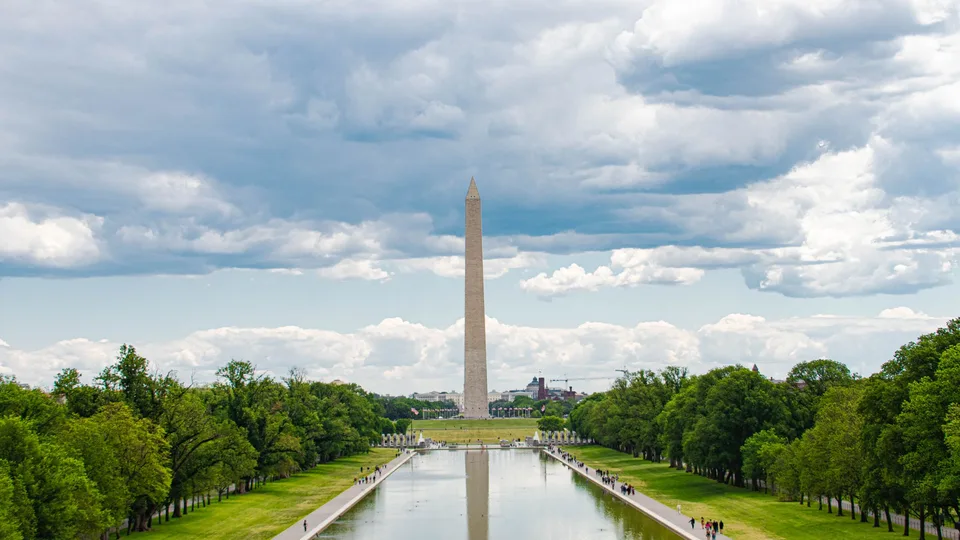
The Mall is a two-mile lawn lined with monuments and museums, and the comfortable way to do it is in slices. Start at the Capitol end in the morning and work west: the US Capitol (free tours, book ahead through the Capitol Visitor Center), the Library of Congress (free, timed pass, and the Thomas Jefferson Building's Great Hall is worth the visit alone), then the museums. The Washington Monument needs a timed ticket — free, with a $1 booking fee if reserved online through Recreation.gov, released 30 days ahead at 10 a.m. Eastern, with a second batch at 3 p.m. the day before and free same-day tickets at the Lodge on 15th Street from 8:45 a.m. It is open 9 a.m. to 5 p.m., last entry 4 p.m., and it closes on December 25, July 4, and one maintenance day a month. The elevator to the top is 555 feet of view — worth it on a clear day, skippable on a hazy one.
At the west end, the Lincoln Memorial is the emotional payoff: 87 steps up from the Reflecting Pool, but there is an elevator and a ramped route on the side, and the new undercroft exhibit below the memorial needs a $1 timed reservation. The Vietnam Veterans Memorial and the World War II Memorial are both on flat ground between the two, and the walk between them is the Mall at its most moving. Go at dusk, when the memorials are lit and the crowds thin.
December in DC: The Christmas Tree and ZooLights
If you come in December, the city gives you two genuinely special evenings. The National Christmas Tree lighting ceremony is Thursday, December 3, 2026, on the Ellipse — but only the ceremony itself is ticketed, and its free lottery closed on November 4. Everyone else gets the better deal: the tree and the 58 smaller trees representing every state, territory, and the District — each hung with student-designed ornaments — are open to the public, free, from December 5, 2026 through January 1, 2027. Walk over after dark, find your home state's tree, and warm up afterward at the Willard hotel lobby a few blocks away, which puts up one of the city's great Christmas trees every year. The ceremony premieres online December 5 if you want to watch the show.
The second evening is ZooLights at the Smithsonian's National Zoo: about a million LED lights and more than 100 animal lanterns across the zoo grounds, on select nights from November 20, 2026 through January 3, 2027 (November 20–22, 27–29, December 4–6, 11–13, 16, 18–23, 26–30, and January 2–3). Tickets are $10 per person, children 2 and under free; hours are 5 to 9 p.m. Monday through Saturday (last entry 8:30 p.m.) and 5 to 8 p.m. Sundays. There is a 21-and-over Adults-Only Night on Wednesday, December 16 ($19). Take the Metro — the Red Line to Woodley Park or Cleveland Park — because zoo parking is $30 in advance or $40 on the day, and the zoo sits on a steep hill: enter at the Connecticut Avenue gate, downhill, and let gravity do the work.
The Free Museums: A 50+ Strategy
Every Smithsonian museum is free, and most are open 10 a.m. to 5:30 p.m. daily. The catch is that a few of the most popular ones now require a free timed-entry pass, and you should book those before you leave home: the National Museum of African American History and Culture, the National Air and Space Museum on the Mall, and the National Zoo (daytime entry). The rest — American History, Natural History, the National Portrait Gallery, the Hirshhorn, the Freer and Sackler galleries of Asian art — are walk-in.
The 50+ picks: the National Gallery of Art (free, on the Mall, with a superb café and a moving walkway between its two buildings), the National Portrait Gallery in Penn Quarter (the presidential portraits, the Obama portraits, and a glass-covered courtyard with chairs — one of the most comfortable rest stops in the city), and the National Museum of American History (Julia Child's kitchen, the Star-Spangled Banner, and the First Ladies' gowns). If you only have one museum morning, make it the Portrait Gallery: it is compact, seated, and unforgettable. One warning worth knowing: if a federal government shutdown is in effect, the Smithsonian museums close — check before you travel.
Getting Around: The Half-Price Senior Metro Fare
DC's Metro is clean, fast, and — for riders 65 and over — half price. With a Senior SmarTrip card, you pay about $1.10 on Metrobus (regular $2.25) and about $1.10 to $3.35 on Metrorail (regular $2.25 to $6.75, depending on distance and time of day). The card itself is free — the usual $2 card fee is waived. The catch is that you enroll in person, with a government-issued photo ID proving your age, at the Metro Transit Accessibility Center at 655 Virginia Ave SW, near L'Enfant Plaza, or at a Metro sales office. For a short trip it is worth the stop if you plan to ride several times; otherwise, a regular SmarTrip card or a contactless bank card works at the fare gates at full price.
Two things to know: the DC Circulator bus is gone — the city ended all Circulator service on December 31, 2024, so older guides that tell you to ride it are out of date — and Metrobus routes were redrawn and renumbered in June 2025, so check the current route before you rely on an old map. Metro stations have some of the longest escalators in the country; every station has an elevator, but elevators occasionally go out of service, so allow extra time and check the elevator status on WMATA's site before a station-dependent trip.
From the airport, Reagan National (DCA) is the easy one: Blue and Yellow line stations sit right at the terminal, about 15 minutes to downtown. Dulles (IAD) is reachable on the Silver Line, about an hour. If you fly into Baltimore (BWI), the MARC train to Union Station is the comfortable option.
Eating Well: Power Lunches, Quiet Dinners
DC eats well, and the 50+ rhythm that works is a proper lunch and a quiet dinner. The museum cafés are better than they have any right to be — the National Gallery's Cascade Café and the Portrait Gallery's courtyard café are both real meals with real chairs. For dinner, the neighborhoods around your hotel do the heavy lifting: Dupont Circle and the Penn Quarter both have plenty of sit-down restaurants with unhurried service, and the city's Ethiopian restaurants (a DC institution, especially around U Street and Adams Morgan) are a genuinely different and delicious evening. Make lunch your big meal; the museums close at 5:30, and an early dinner near your hotel beats a late one across town.
Safety: Comfortable, With Normal City Sense
The Mall, the museums, Penn Quarter, and Dupont Circle are well-policed tourist areas and feel comfortable day and evening, including for solo women travelers over 50. The usual advice applies — crossbody bag, awareness in crowds, rideshare rather than walking alone late at night in unfamiliar blocks. The main practical risk is not crime but distance and weather: December is cold (typically in the 40s Fahrenheit), the Mall is exposed, and the wind off the river bites — dress in layers and use the museums as warm-up stops.
Day Trips: Old Town Alexandria and Mount Vernon
Old Town Alexandria, Virginia, is the gentle day trip: a 20-minute Metro ride (Blue or Yellow to King St–Old Town), then a flat, cobbled waterfront of 18th-century streets, the free King Street Trolley, and the Torpedo Factory art studios. It is the slower, smaller-scale counterpart to the Mall, and it pairs well with a DC base; see our Charleston guide if you like this kind of walkable historic town. Mount Vernon, George Washington's home, is about 30 minutes by car or a Metro-plus-bus combination — the mansion tour, the gardens, and the Potomac view are worth the trip, and the grounds are manageable at a slow pace with benches throughout. If you are planning 2027 travel and open enrollment is on your mind, our Medicare Part B 2027 guide covers the December 7 deadline before you book next year's trips.
Area Map
Frequently Asked Questions
Is Washington DC a good trip for travelers over 50?
Yes — it is one of the most affordable US city trips after 50. The Smithsonian museums are free, the National Mall is flat, the Metro gives riders 65 and over half fare, and most of the big sights are seated, indoor, and elevator-accessible. The catch is scale: the Mall is about two miles end to end, so the 50+ strategy is to plan one museum per half-day and ride the Metro between stops instead of walking the whole thing.
Is there a senior discount on the DC Metro?
Yes. Riders 65 and over pay half fare on Metrorail and Metrobus with a Senior SmarTrip card — about $1.10 on Metrobus (regular $2.25) and about $1.10 to $3.35 on Metrorail (regular $2.25 to $6.75). The card itself is free; you enroll in person with a government photo ID proving your age, at the Metro Transit Accessibility Center at 655 Virginia Ave SW near L'Enfant Plaza, or a Metro sales office.
Do I need timed tickets for the Smithsonian museums?
Most Smithsonian museums are walk-in and free, but several popular ones require a free timed-entry pass: the National Museum of African American History and Culture, the National Air and Space Museum on the Mall, and the National Zoo. The Washington Monument also needs a timed ticket — free, with a $1 booking fee if reserved online through Recreation.gov, released 30 days ahead at 10 a.m. Eastern. Book the passes before you leave home.
Can I see the National Christmas Tree without a ticket?
Yes. Only the December 3, 2026 lighting ceremony itself is ticketed, and its free lottery closed November 4. The tree and the 58 smaller state and territory trees on the Ellipse are open to the public, free, from December 5, 2026 through January 1, 2027 — just walk over after dark. The ceremony premieres online December 5 if you want to watch it.
When is the best time to visit Washington DC after 50?
Late March to early April for the cherry blossoms, or December for the holidays: the National Christmas Tree on the Ellipse (December 5 to January 1) and ZooLights at the National Zoo (select nights November 20 to January 3). November is the quiet-value month — mild weather, thin crowds, and lower hotel rates. Summer is hot, humid, and crowded; January and February are cold but the museums are empty.
Get Price-Drop Alerts for This Destination
Watching fares? We'll email you when prices drop 10% or more. Free.
Set a Free Price Alert →More US city guides: Boston After 50 · Charleston After 50 · Nashville After 50